
Huge 3D Textured Abstract Paintings - Palette Knife Impasto and the Art of Sculptural Walls
A Huge 3D textured abstract painting is more than wall decoration. It is a physical object that occupies space the way sculpture does. Thick ridges of paint catch light, cast moving shadows, and invite the eye to travel across a surface that is never flat. In contemporary interiors with high ceilings, open plans, and large unbroken walls, these works have become a preferred way to add presence without clutter.
The effect is created primarily through the palette-knife and impasto tradition. Artists load a flexible metal blade with heavy-body acrylic or oil and apply, scrape, or carve the paint so that it stands proud of the canvas. The result is a surface that changes throughout the day as natural or artificial light rakes across it.
From Mixing Tool to Sculptural Instrument
The palette knife began as a practical studio tool. Renaissance painters used similar blades to mix pigments and apply grounds. By the seventeenth century Rembrandt was already employing it, alongside brushes and fingertips, to build the tactile flesh and fabric of his late portraits.
In the nineteenth century the knife moved from mixing to mark-making. Gustave Courbet used it to give rocks and earth a sculptural weight. Vincent van Gogh, though better known for his brushwork, frequently scraped passages with a knife and laid paint so thickly that the surface itself became expressive. His letters describe the satisfaction of working “à la Monticelli,” building a single flow of impasto.
Tate defines impasto simply as “an area of thick paint or texture in a painting.” The technique first appears noticeably in Venetian Renaissance work, becomes more pronounced in Baroque and Romantic painting, and reaches an extreme in the mid-twentieth century with artists such as Frank Auerbach, whose pictures can approach three-dimensional relief.
Abstract painters found the method especially useful. Because the subject is no longer a depicted object, the physical behavior of the paint—the peaks, the dragged edges, the broken color—can become the entire content. Hans Hofmann and Willem de Kooning exploited this freedom; later painters continue to do so at architectural scale.
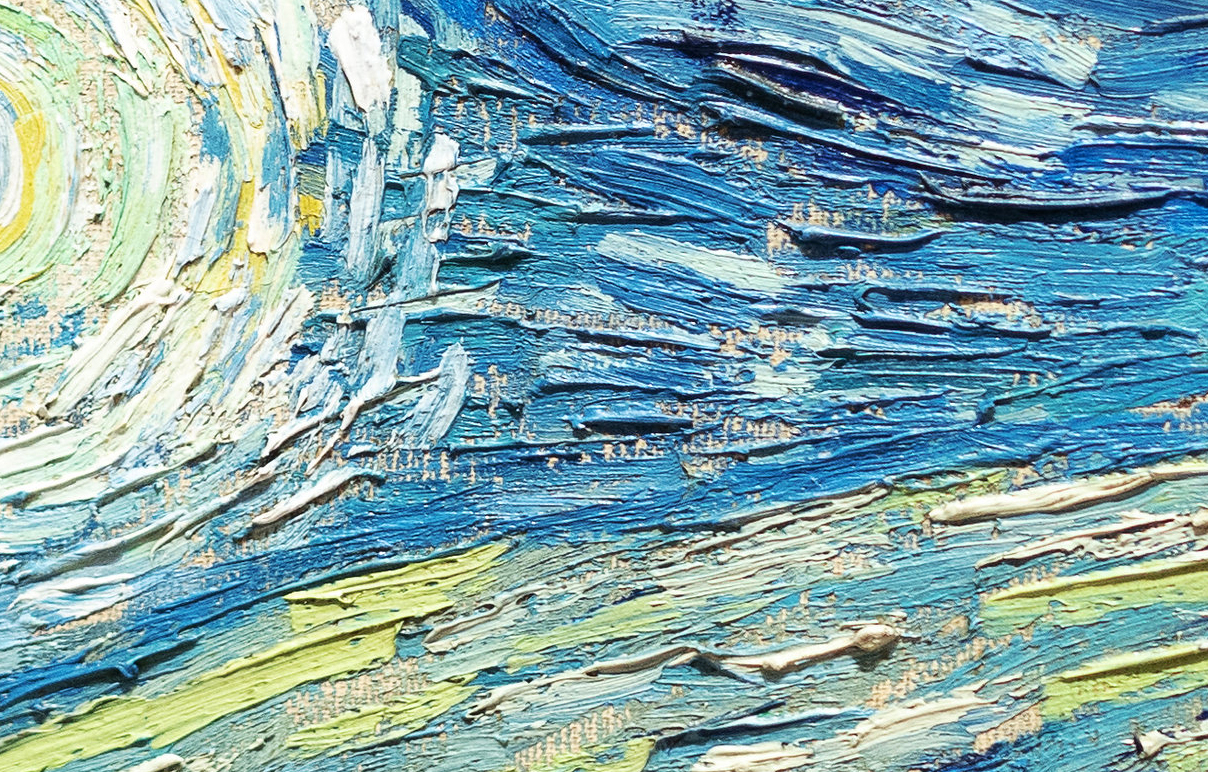
A close look at Van Gogh’s The Starry Night still reveals how thick, directional strokes create both movement and actual physical depth. Contemporary palette-knife work simply enlarges that principle.
How Texture Becomes Three-Dimensional
The 3D quality is optical and tactile at once. Raised ridges catch raking light and throw small shadows; valleys recede. Metallic or iridescent pigments amplify the effect. Because the surface is uneven, the painting never looks the same twice. Morning light emphasizes one set of planes; evening light another.
Artists typically work with heavy-body acrylics or oils, sometimes mixed with modeling paste or gel medium so the paint holds its shape. A single stroke can leave a ridge several millimeters high. On a large canvas those ridges become landscape-like: waves, strata, or tectonic folds. The viewer’s movement around the work completes the sculpture.

The process itself is physical. The knife is loaded by scraping sideways across a pile of paint, then pressed, dragged, or flicked. Subsequent layers can be laid wet-into-wet or allowed to skin over so later strokes sit on top. Sgraffito—scratching back through a wet layer—reveals earlier color and adds linear texture.
Why Size Matters
A small textured painting reads as a precious object. A huge one becomes architecture. In rooms with two-story ceilings or long sight-lines, a work measuring two or three meters in one direction can balance furniture, window walls, and empty space. Designers note that a single large piece often replaces a collection of smaller frames, simplifying the visual field while increasing impact.
Scale also changes how texture is perceived. On a modest canvas, impasto can look merely decorative. On an oversized surface the same marks become immersive; the viewer can stand several meters away and still feel the topography. The painting begins to function as a quiet, constantly shifting light-modulator.

Neutral palettes—warm whites, taupes, charcoal, muted golds—let the texture do most of the work and sit comfortably with both minimalist and more layered interiors. Stronger color fields or metallic accents can supply a focal point in otherwise restrained rooms.
Practical Advantages in the Home
Textured surfaces do more than look interesting. They add a subtle acoustic softness to hard-edged modern rooms. They introduce warmth against glass, steel, and polished stone. Because the work is abstract, it does not dictate a narrative; occupants can project their own mood onto it. Many owners report that the changing play of light and shadow gives the room a living quality that a printed or smoothly painted canvas cannot match.
Lighting is critical. A picture light or adjustable track that can graze the surface from a shallow angle will reveal the relief. Diffuse daylight from a side window works equally well. Avoid harsh, frontal illumination that flattens the topography.
Care is straightforward. Acrylic versions dry quickly and are relatively robust; oil versions require longer curing and more caution with humidity. Dust is best removed with a soft brush rather than a cloth that might catch on peaks. The paintings are usually gallery-wrapped on deep stretcher bars so they can hang without a frame, or they can be floated in a simple contemporary frame.
Choosing and Commissioning Work
Because these paintings are labor-intensive, they are almost always handmade rather than printed. Many studios offer customization of size, color temperature, and even the height of the relief. A collector can therefore match a specific wall, sofa length, or existing palette. The collection at BigArtify, for example, specializes in precisely this combination of large format and palette-knife texture.
Materials matter. Professional-grade heavy-body paints and properly primed canvas or panel reduce the risk of cracking as the thick layers dry. Artists who work at this scale usually apply paint in stages, allowing each layer sufficient time to set.
A Continuing Tradition
The appeal of a huge 3D textured abstract painting is both historical and contemporary. It continues a lineage that runs from Rembrandt’s late portraits through Courbet’s earth, Van Gogh’s skies, and the Abstract Expressionists’ emphasis on the act of painting itself. At the same time it answers a current desire for authenticity, tactility, and presence in interiors that can otherwise feel sleek to the point of sterility.
The knife, once a humble mixing tool, has become a way of thinking in three dimensions on a two-dimensional support. When that support is large enough to occupy a wall the way a window or a fireplace does, the result is a piece of architecture that happens to be made of paint.
Frequently Asked Questions
What exactly is a 3D textured abstract painting? It is an abstract work in which paint is applied so thickly—usually with a palette knife—that the surface has actual physical relief. Light and shadow on the ridges create a three-dimensional appearance that changes with viewing angle and lighting.
How is palette-knife painting different from traditional brushwork? A brush tends to blend and leave bristle marks. A knife lays down discrete planes, sharp edges, and sculptural peaks. Colors stay cleaner because they are not mixed on the surface as thoroughly.
Why choose a huge size rather than a smaller canvas? Scale turns texture into an environmental experience. In large rooms a modest painting can look lost; an oversized work can define the space, balance architecture, and remain readable from a distance.
Will the thick paint crack over time? Properly executed work using professional heavy-body paints and layered application is stable. Acrylics dry faster and are less prone to cracking than oils. Extreme fluctuations in humidity should still be avoided.
Can the colors and size be customized? Yes. Many contemporary studios that specialize in this technique accept commissions for specific dimensions and color schemes so the painting can be tailored to a particular wall or interior palette.
What is the best way to light a textured painting? Use raking light—light that strikes the surface at a shallow angle. This emphasizes ridges and shadows. Picture lights, adjustable spots, or side-window daylight all work well. Avoid even, frontal lighting.
Are these paintings suitable for high-traffic or humid rooms? They can be, provided they are acrylic rather than oil and are not placed in direct steam or extreme temperature swings. A protective varnish is sometimes applied.
How do I clean the surface? Use a clean, dry, soft brush to lift dust. Do not wipe with a cloth, as fibers can catch on raised paint. Professional conservation is recommended for any significant soiling.