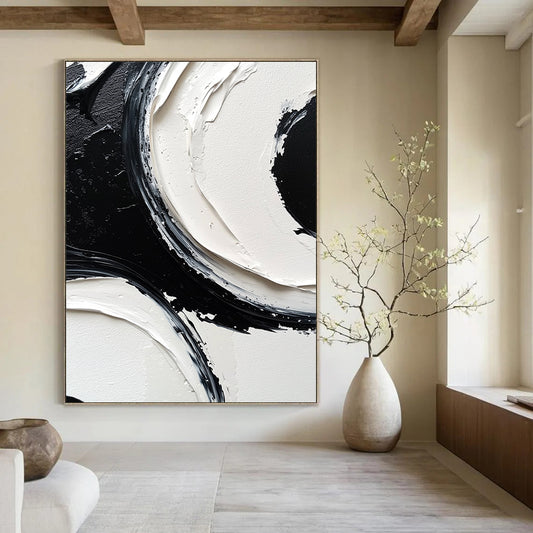
How to Choose a Painting Knife Painting That Has Surface, Not Printed Roughness
A brush can describe a wave. A blade can build one. Painting Knife Painting is oil or heavy acrylic laid on with a metal edge—dragged, pressed, and scraped—so the paint stands off the canvas and takes light. This guide is for handmade knife work on large canvas: textured trees, impasto waves, floral relief, city reflections, and thick abstract fields. It is not for a photograph of texture, and it is not for a thin wash that only claims to be sculpted.
Painting knives and palette knives are close cousins. The palette knife began as a mixer. The painting knife is angled to put paint on the wall. Shops use the names as one category. What you are buying is the ridge.
Why the blade changed the surface
Thick paint is older than the modern abstract market. Gustave Courbet cut rocks and broken shorelines with a knife so the land had weight, not polish. The Black Rocks at Trouville (1865/66) at the National Gallery of Art is a small canvas with a carved coast. Vincent van Gogh loaded paint until the stroke itself became the weather. The Starry Night (1889) at The Museum of Modern Art is famous as an image; in the room it is also a map of ridges. The Tate’s note on impasto is the clean definition: paint thick enough that the mark stays visible, and the surface has its own reality instead of pretending to be a window.
The buying translation is practical. If the light in your room cannot rake across the canvas, you are paying for a picture of texture. If it can, the knife work earns the price.
Read the ridge before you read the subject
- Open knife planes—wide pulls of one color—suit living rooms and high walls. They read from across the room.
- Short, stacked marks—leaves, foam, petals—need closer viewing. They suit a dining wall or a hall you pass.
- Sculpted relief (flowers, waves built up in paste) is the most physical. Confirm the listing is painted, not a cast print of a wave.
- Scraped grounds with thin color in the valleys feel contemporary and quieter than a fully loaded sunset.
Ask how much of the canvas is actually built. A few ridges on a flat field can be enough. A surface packed edge to edge will collect dust and throw busy shadows under a single downlight.
Subject is secondary in this collection. Trees, horses, umbrellas, flags, and cubist blooms all use the same tool. Buy the temperature and the height of the paint first. A gold-and-blue city reflection and a teal wave can live in the same room if the ridges are similar in scale.
Rooms, light, and how close you stand
Knife paintings want a raking light: a lamp or window that hits the surface from the side so the ridges cast a short shadow. Flat, cool overhead LEDs flatten the work into a photograph. Warm, dimmable light (about 2700–3000K) keeps white foam and gold leaf-marks from going chalk.
Living rooms take large, open knife planes above a sofa. Bedrooms take softer relief—white blossoms, muted surf—not a high-chroma flag or a galloping horse unless that is the point of the room. Offices can take monochrome circles and scraped blacks; they look deliberate rather than decorative. Hallways are good for smaller, denser textures because you see them at arm’s length.
Do not hang the thickest relief where people will brush it. A hallway corner at shoulder height will pick up jackets. Give built paint a little air.
Size, thickness, and shipping
Above a sofa, bed, or console, aim for about 60–75 percent of the furniture width. A 90-inch sofa wants a canvas roughly 54–68 inches wide. Leave 6–8 inches between the furniture and the work. On an empty wall, keep the visual center near 57–60 inches from the floor.
This shop lets you choose size and, on many listings, how thick the paint should be. Use that. A hallway piece can stay moderate. A high wall can take a heavier load because you stand farther back. Extreme thickness looks dramatic in a thumbnail and heavy in a small room.
Deep relief often ships stretched, not rolled. If a piece is rolled, the highest ridges can flatten in the tube. Ask before you order a “3D wave” as a roll. Gallery wrap with painted sides is the cleanest finish; a heavy gilt frame fights the sculpture.
Care and a short checklist
Dust with a soft, dry brush along the valleys. Do not wipe a loaded ridge with a damp cloth. Keep the work out of hard, all-day sun and out of steamy kitchens. Oil knife work dries slower than acrylic; newly painted pieces should not go into a sealed crate against another surface.
Confirm three things in the listing: handmade, oil or heavy-body acrylic, and whether thickness is custom. Then match the ridge to the light you actually have, not to the photo on a phone.
How can I tell a painting knife painting from a print of texture?
Look at the edge of a ridge in a close photo, or ask for a raking-light shot. Real knife work has irregular peaks, color mixed on the canvas, and valleys that are not a repeating pattern. A print of texture repeats the same bump and has no shadow that changes when you move.
Should I choose oil or acrylic for knife work?
Oil stays open longer and can be pulled into longer planes. Acrylic with paste builds faster and ships sooner. Both can hold a ridge. If you want maximum height and a slower studio process, oil. If you want custom size on a shorter timeline, heavy acrylic is the usual path.
How thick should the paint be on a living-room canvas?
Enough to catch side light from six to ten feet, not so much that the surface looks like icing. Moderate to heavy is the livable range. Extreme relief belongs on a wall you do not walk past with a coat on.
How do I clean the ridges?
Use a dry, soft brush. Work with the direction of the pull, not against a sharp peak. Skip household spray and wet cloths. Kitchen grease is the usual enemy; do not hang the thickest work over a stove.
Will a painting knife canvas ship rolled?
Thin and moderate surfaces sometimes can. Deep 3D relief usually should not. If the listing offers both, choose stretched when the paint is built. A crushed ridge does not recover the way a crease in a flat print does.