How to Choose Line Art That Still Reads When the Line Is the Whole Event
Line art is easy to fake and easy to lose. A thin black mark on a pale canvas looks decisive on a phone and disappears on an eight-foot wall. Line art that holds is a decision about pressure, interruption, and ground—not a face drawn in one continuous Instagram stroke.
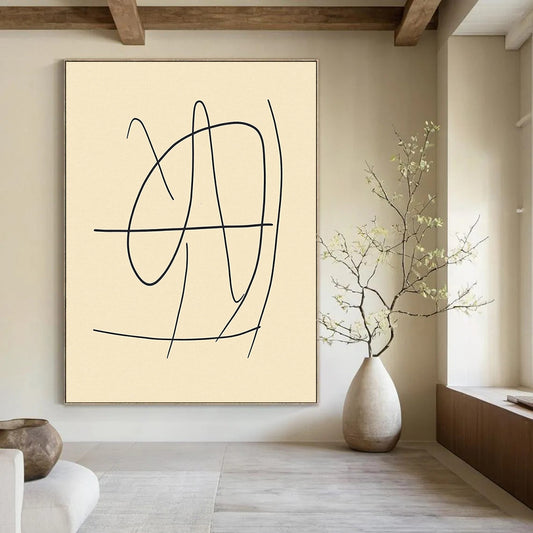
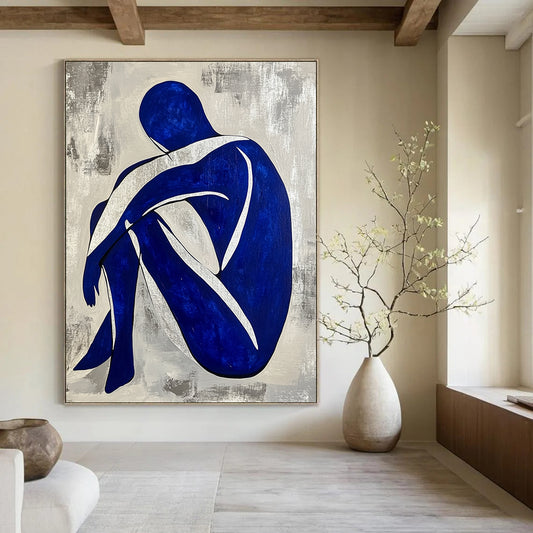
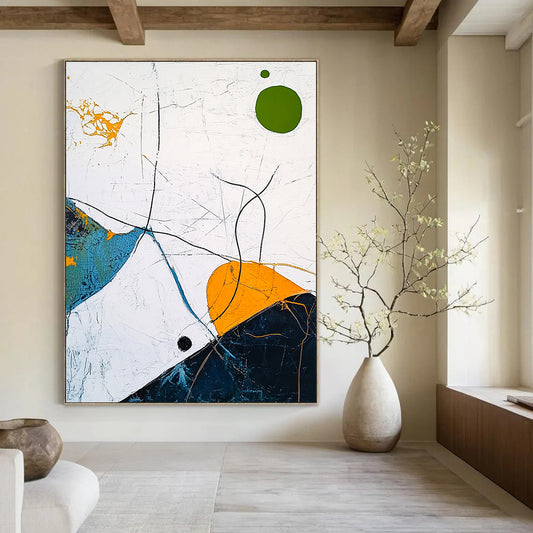
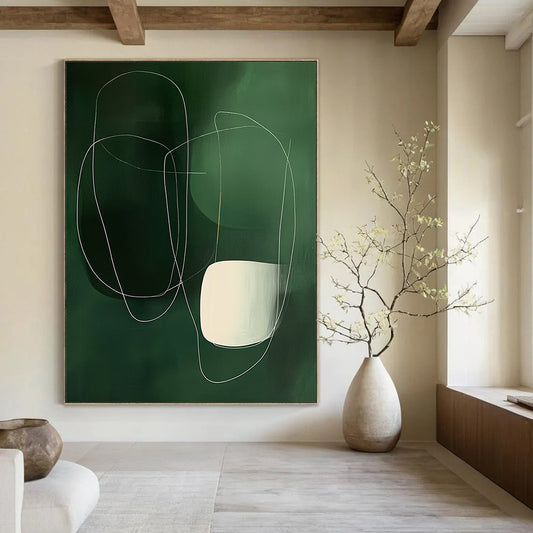
Line Art in this collection means hand-painted canvas built from few marks: a horizon reduced to a traverse, white lines on gray, an etched field, a landscape that kept only its edges. The listing is a language of line. The piece you receive is painted to order in that language, not a printed contour.
A line is an edge before it is a style
Wikipedia’s article on line art is blunt: distinct lines against a ground, usually one color family, form indicated by contour rather than by modeled shade. Print culture used that economy because a line could be cut, etched, or inked. A contemporary canvas that works still uses the same economy. If you fill the field behind the line until the line is only decoration, you no longer have line art. You have a picture with a scribble on it.
Tate’s glossary on drawing starts with images made by lines, then admits washes and tone. That admission is useful in a living room. Pure line on raw canvas can look unfinished next to oak and a screen. Line plus a quiet ground—gray, clay, a stained linen—lets the mark sit as architecture. The question is which element is in charge. If the ground is busier than the line, the category is wrong.
Paul Klee gave the mark its most durable sentence. MoMA’s Portrait of an Equilibrist is a linear construction that also reads as a face, and the museum repeats Klee’s definition of drawing: a line going for a walk. You are not buying a Klee. You are borrowing the test. Does the line have a walk—an origin, a pressure change, a place it decides to stop—or is it a vinyl decal of a walk?
A working split:
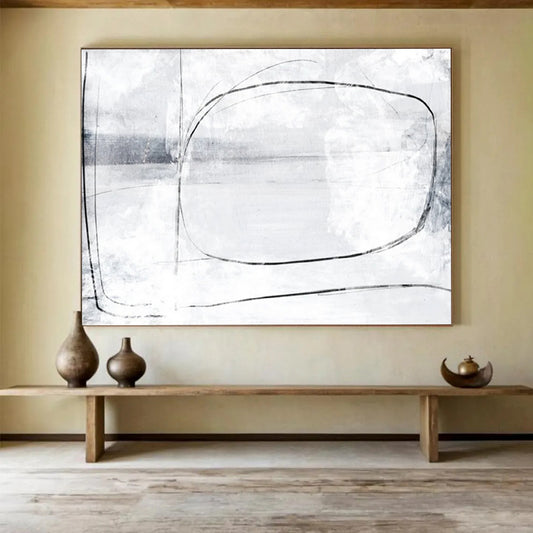
- Traverse: one or two lines that cross the field like a horizon or a path.
- Lattice: a few related marks, still countable.
- Contour of a place: landscape reduced to edges, not a view with outlines added.
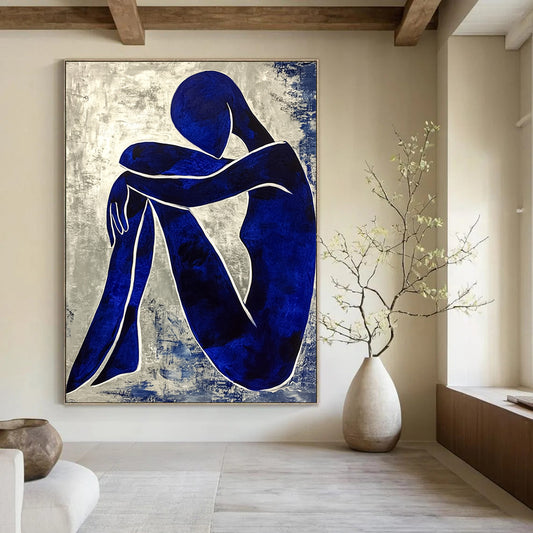
- One-line face: a fashion graphic. Right for a powder room if you mean it. Wrong as the only object on a long seating wall unless the line is large and the ground is serious.
Resin-on-linen and “monumental powder room” titles in the grid are other products. If the work needs pours and gloss to exist, it is not primarily line.
How a thin mark occupies a thick wall
Scale is the hallway-and-sofa problem specific to this category. A pencil-weight line on an extra-large canvas will vanish by the time you sit down. Either enlarge the mark until it has a body—brush width, knife edge, a painted ridge—or keep the canvas closer to the distance you pass. Line art over a sofa has to be stout enough to read from the far chair. Line art in a hall can be finer, because you pass closer.
Ground is half the picture. White line on mid-gray holds in mixed light. Black line on optical white can look like a poster, or like a drawing taped up, depending on the weight of the mark. Cream and clay grounds sit with oak. Cool gray grounds sit with stone and steel. A busy printed texture behind a thin line is a fight the line will lose.
Light is unkind to skinny marks. A downlight on pale canvas bleaches the field and leaves the line as a hair. Side light helps if the line is slightly built—a ridge of paint, an incised groove. Glossy resin will turn a quiet drawing into a tile. Matte or satin keeps the walk visible.
One line is a protagonist. Two or three related canvases can form a beat along a hall if they share weight and ground. A cluster of unrelated “minimalist line” leftovers looks like a stationery shop.
Handmade line is the reason to order paint. A printed contour is the same width from end to end. A painted line changes: it fattens, skips, scrapes. Look for close shots of the mark itself, oil or acrylic or ink on canvas, painted to order. Approve photos before it ships. Custom size exists so the walk fits the span—not so a tiny face is blown up until the line becomes spaghetti.
A short buying order
- Decide traverse, lattice, reduced landscape, or (rarely) a face.
- Measure viewing distance, not only wall width.
- Choose a ground that is quieter than the line.
- Make the mark stout enough to read from the far chair.
- Check sheen; keep resin off a drawing wall unless you mean tile.
- Review photos of the finished line before it ships.
Line art that still works is a walk you can see. A decal is what you get when the only brief was “minimal.”
Is a one-line face the same as line art?
It is one fashion of line art, not the whole category. A face needs enough scale and a serious ground or it reads as a print from a trend cycle. A traverse or reduced landscape usually lasts longer on a main wall.
Why does the line disappear when the canvas is huge?
Because the mark stayed the width of a sketch. Enlarge the line—brush, knife, a painted ridge—or keep the canvas closer. Extra-large fields require extra-large decisions.
What ground works with oak furniture?
Clay, warm gray, and cream. Optical white with a hairline black mark often looks like stationery. Ask for a dirtier field if the listing runs icy.
Can I hang two line canvases as a pair?
Yes, if they share weight, ground, and centerline. Two unrelated “minimal” leftovers with different line thicknesses will look unfinished.
Is textured paint compatible with line art?
A low ridge that is the line can help. A heavy plaster field with a thin scribble on top is texture wearing a line costume.
Can I order a heavier line or a custom span?
Yes. Send the wall width and a photo from the chair or doorway you use. Keep the same walk as the listing, with more body in the mark if the canvas is large. Approve images of the finished surface before shipping.