How to Choose Large Abstract Wall Art
Scale is the first decision, not the last. A painting that looks generous on a product page can vanish over a sectional. One that looks bold on a phone can swallow a narrow dining wall. This guide is for people buying a single large canvas—or a custom-sized one—rather than a gallery of small prints.
Browse BigArtify’s Large Abstract Wall Art with a tape measure in hand. The notes below are about proportion, surface, color, and the rooms these paintings actually have to live in.
Why large abstraction still works on domestic walls
Twentieth-century painters learned that a canvas can hold a room without depicting a room. Abstract expressionism made scale part of the meaning: gesture, stain, and color field were meant to be seen with the body, not only with the eye. The Guggenheim’s overview of Abstract Expressionism places that shift in postwar American painting, when large abstract canvases became a primary language rather than a decoration around a subject.
You are not buying a museum canvas. You are using the same principle. A large abstract field can quiet a busy open plan, finish a high wall, or give a sofa something to answer. The painting has to be big enough to behave like architecture—and still leave the furniture its own space.
Measure the wall, then the furniture
Write three numbers before you look at colors.
Wall width. Art should usually occupy about 60–75 percent of the open wall, not the entire span. Full-bleed canvases look theatrical in lofts and cramped in ordinary rooms.
Furniture width. Above a sofa, a console, or a bed, start with two-thirds of the furniture width. An 84-inch sofa wants something in the mid-50s to low-60s unless you are deliberately going oversized.
Ceiling height. On an 8-foot wall, a very tall canvas will sit on the baseboard in spirit even if it hangs at the “correct” height. On a two-story stair or a great room, a squat panorama looks like a stamp. Height is a separate purchase from width.
Standard interior hanging puts the visual center near 57–60 inches from the floor. Over a sofa, raise that so the bottom edge clears the back cushions by 6–10 inches. Do not hang “gallery height” and sofa height as if they were the same rule.
Gesture versus field: two kinds of large abstract
Not every large abstract asks the same thing of a room.
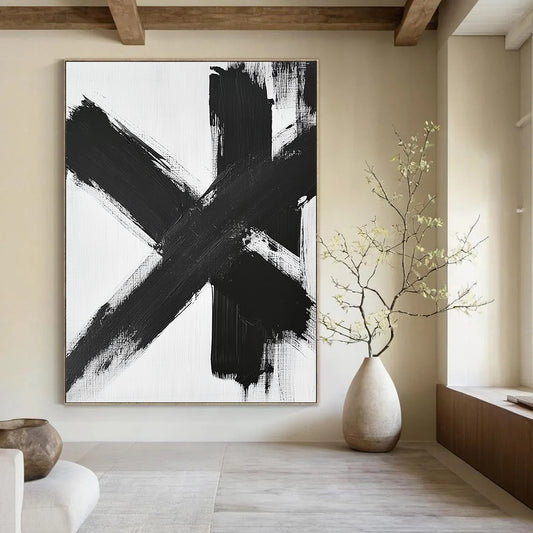
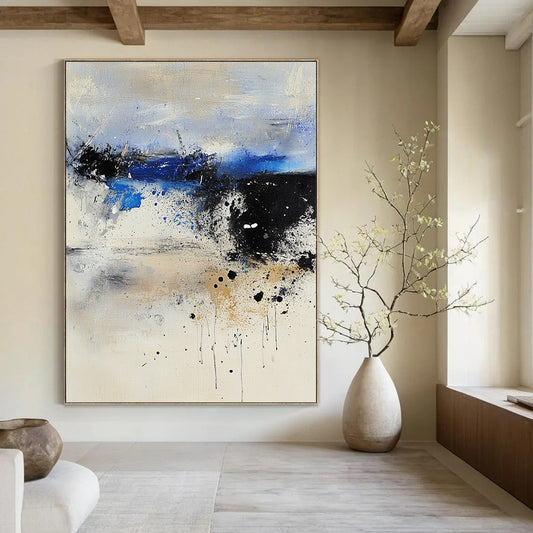
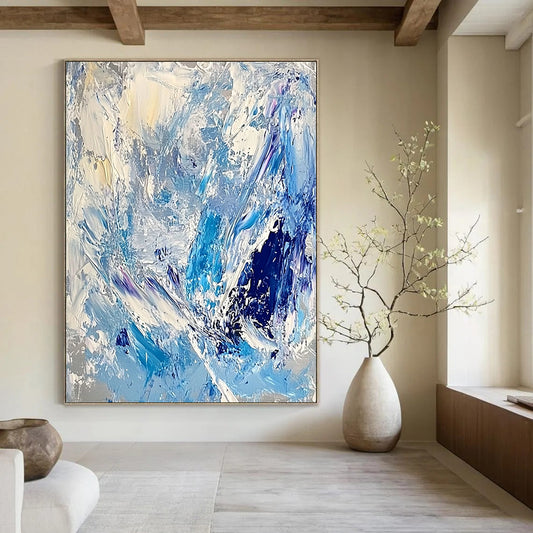
Gestural work keeps visible strokes, drips, scumbles, and collisions of color. It suits rooms that are already calm—plain walls, simple sofa, little pattern. In a busy family room it competes with toys, throws, and television.
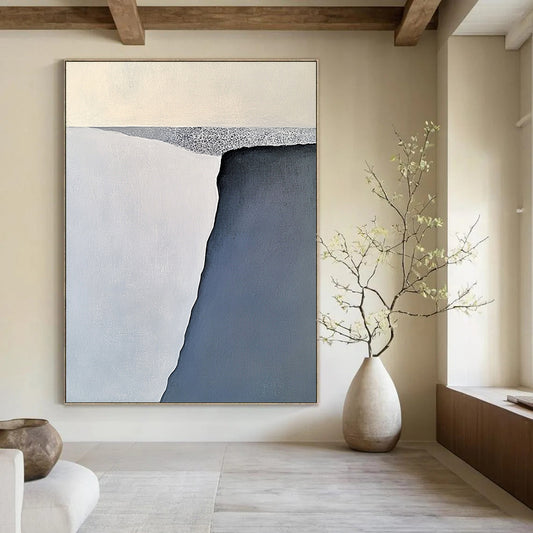
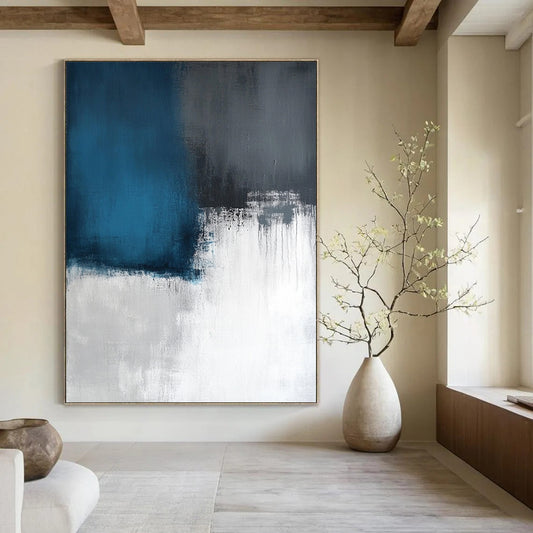
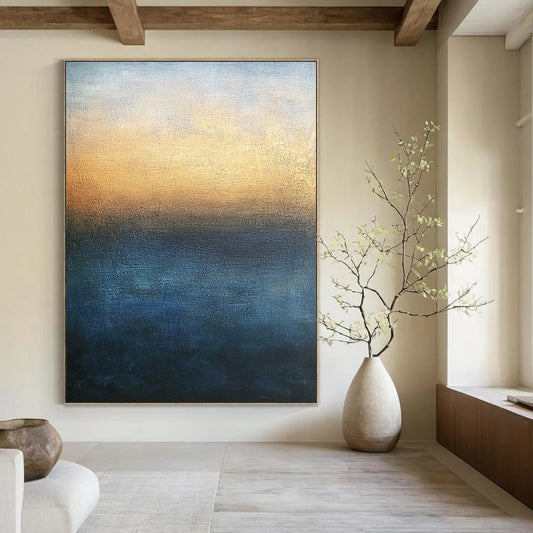
Color field work spreads broad, relatively even areas of color. Wikipedia’s entry on color field painting describes large, consistent surfaces that downplay busy brushwork in favor of an unbroken plane. That is useful above a sectional or in a bedroom: the wall gets presence without visual chatter.
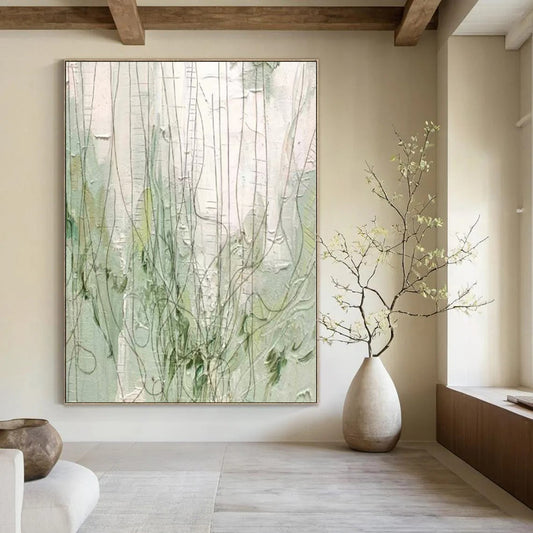
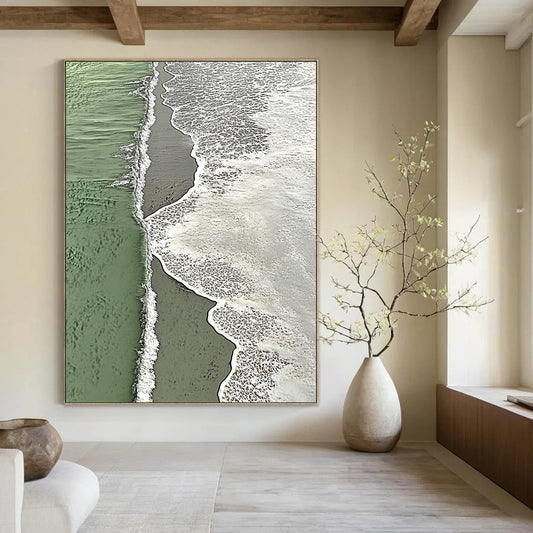
A third common studio hybrid is textured field—quiet shapes built with palette knife or impasto so the surface changes when daylight moves. Texture is not a style name; it is a lighting decision. Side light from a window makes ridges readable. Flat overhead downlights can erase them.
Color that survives real rooms
Thumbnails lie about saturation. A cobalt that looks sophisticated at two inches can dominate a north-facing living room.
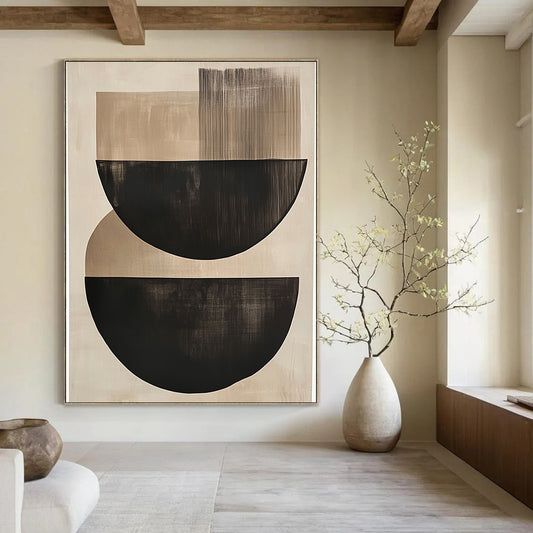
- Neutrals with one accent (graphite, sand, chalk, plus a single rust or ink) are the most forgiving next to wood and stone.
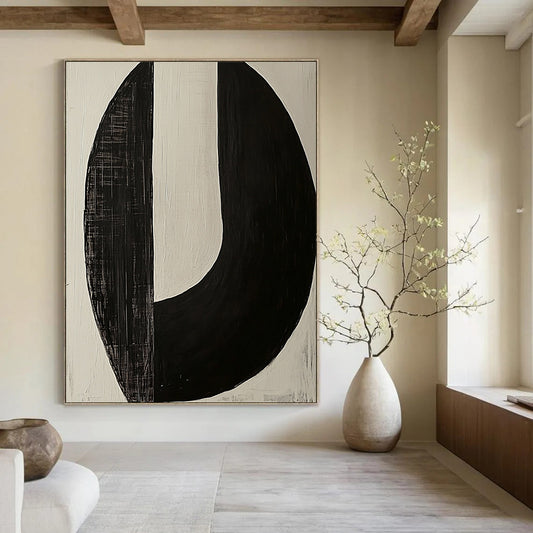
- High-contrast black and white needs clean architecture. Pair it with oak or wool so the room does not feel clinical.
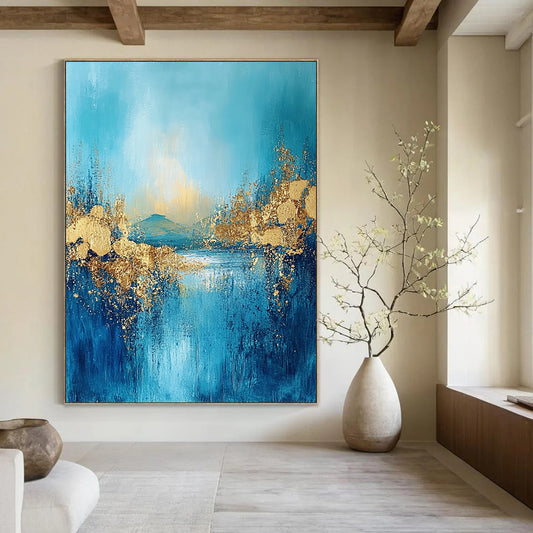
- Gold leaf or metallic bands catch evening light. Use them on a quiet wall, not in a room already full of brass and veined marble.
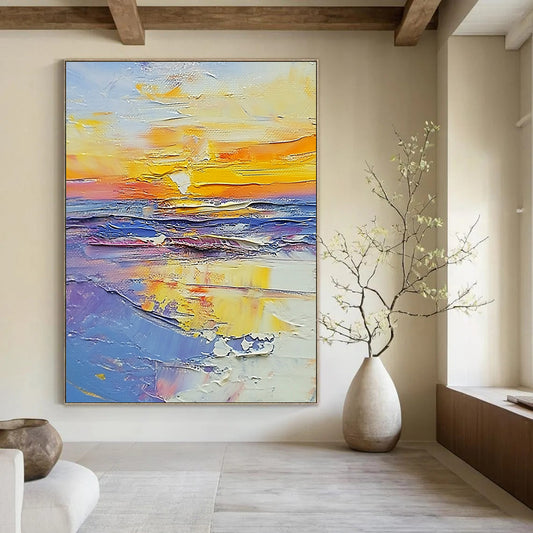
- Full-spectrum “rainbow” abstracts need a room that can absorb them—rarely a small bedroom.
Look at a detail crop of the actual paint, not only a digitally staged interior. You are buying surface as much as composition.
Custom size is the practical luxury
Made-to-order canvas exists because walls are not SKUs. If the niche is 71 inches, a 60-inch standard leaves an awkward plaster frame. If the stair is tall and narrow, a landscape format will always look wrong.
When you commission:
- Confirm whether the listed size is image only or includes a frame.
- Ask if an oversized piece ships rolled in a tube and who stretches it on arrival.
- Keep the composition’s proportions. Stretching a square idea into a 2:1 panorama is a different painting.
- Limit color changes to temperature and value (navy instead of black, warmer gray instead of cool). Rewriting the whole design in comments usually weakens it.
Rooms, briefly
Living room. One large horizontal or a generous square. Avoid a row of small abstracts unless you want a gallery wall on purpose.
Bedroom. Lower contrast, fewer hot spots of color. The painting should still read from the door.
Dining room and hallway. These are walking views. Broad shapes beat compositions that only resolve at arm’s length.
High ceiling / open plan. Go larger than the sofa rule if the wall is a full story. The painting has to hold empty air, not only the furniture line.
A short checklist before you order
- Wall, furniture, and ceiling measured.
- Format chosen (horizontal, vertical, square) to match the void, not the thumbnail.
- Gesture or field decided against how busy the room already is.
- Palette limited; metallic used on purpose.
- Shipping, stretching, and unframed depth confirmed.
- A close photograph of the real surface reviewed.
Large abstraction is less about finding a picture you “like” in a grid of fifty and more about choosing a plane of color and texture that can stand in for architecture. Get the size right first. The rest of the painting has somewhere to go.
What size counts as large abstract wall art?
In homes, “large” usually starts around 36–40 inches on the long side and becomes “statement” above about 48 inches. Extra-large pieces for high walls often run 60 inches and up. Use the wall and the sofa, not the label on the product card.
How high should I hang a large canvas above a sofa?
Leave 6–10 inches between the top of the back cushions and the bottom of the canvas. Then check that the visual center of the painting still sits near standing eye level. If those two rules fight, the canvas is probably too tall for that wall.
Will a very large abstract make a small room feel smaller?
A single well-sized field often makes a room feel calmer and more intentional. What shrinks a room is a canvas that runs edge to edge, or many competing small frames. Keep a margin of wall around the painting.
Is textured paint worth it on a large canvas?
Yes if the wall gets sidelight and you want the surface to change through the day. No if the only light is flat and overhead, or if you need a washable, perfectly smooth face. Ask for a detail photo of the impasto, not only the overall design.
Can I put large abstract art in a bedroom?
Yes. Choose lower contrast and fewer sharp color clashes. Soft fields and muted palettes read as rest; high-chroma action painting can feel like a second screen.
Print or hand-painted canvas for a large wall?
A print is fine when you need a known image at a modest size. On a large wall, hand-painted canvas holds up better because edges, layers, and slight irregularity catch light. Custom proportion is the other reason to paint rather than enlarge a file.