
Large Wall Art for Living Room: A Practical Guide
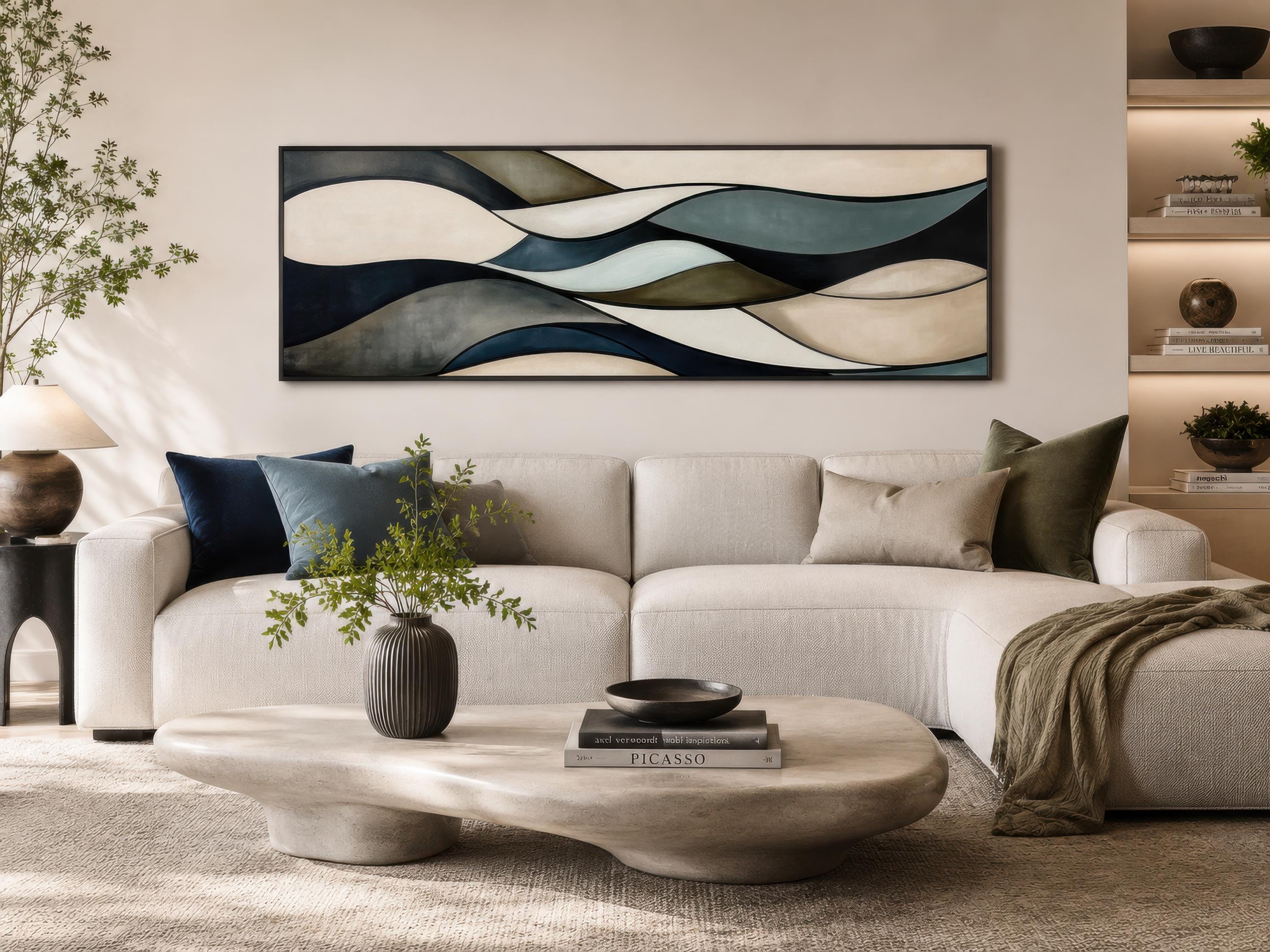
A living room is the one wall most people get wrong. The sofa is wide, the ceiling may be ordinary or double-height, and the view from the doorway is unforgiving. Small prints that looked fine in a hallway vanish here. Large Abstract Wall Art exists for that problem: one handmade field large enough to organize the room instead of a cluster of leftovers.
This guide is for living rooms only. It covers where large art belongs, how big it should be, how high to hang it, which colors survive daylight and lamps, and when one canvas is better than many.

What “Large” Means in a Living Room
In a bedroom, 36 inches can feel generous. In a living room it often looks like a sample. For sofa walls, “large” usually starts around 48 inches on the long side and becomes a statement at 60 inches and up. Extra-wide sectionals and open-plan rooms often need 70–90 inches, or a measured pair that adds up to the same span.
Interior design treats the living room as a public room inside the house. People enter it standing, then sit. Art has to work at both distances. A canvas that only looks finished in a product crop will fail from the kitchen opening.
Abstract art makes scale even more important. There is no painted figure to tell the eye how big the image is. Size itself becomes the subject. That is why a quiet beige field can hold a living room if it is large enough—and why a busy small abstract cannot.
The Sofa Wall Comes First
Most living-room art lives above the sofa. Measure the sofa arm to arm. Aim for art that spans about 60–75 percent of that width. Leave 6–10 inches between the sofa back and the bottom of the canvas. In a standard room, the center of the work should land near 57–60 inches from the floor.
Those two rules—span and gap—do more than any palette trend. Proportion in architecture is the same idea at building scale: parts relate to one another and to the whole. The sofa is one part. The painting is the other.
A standard 84-inch three-seater usually wants 56–63 inches of art. A 96-inch sofa wants 60–72 inches. A sectional whose wall-facing back is 110 inches needs a truly wide canvas or a pair measured as one object, including the gap between panels.
Do not center the painting on the wall if the sofa is not centered. Center it on the furniture. The living room reads the seating line first.
Other Living-Room Walls Worth Using
Not every large canvas belongs over the sofa.
Fireplace wall
Treat the mantel as you would a sofa back. Keep a short gap above the mantel shelf. The art should be narrower than the full chimney breast if stone or tile already frames the opening, and wide enough to finish the mass of the fireplace.
Empty side wall
An unused plane between windows, or the wall opposite the sofa, can take a vertical or square work. This is useful when the sofa wall already has a television.
Open-plan divider wall
If the living room shares volume with the kitchen or dining area, the canvas has to read from 15–20 feet. Simple large fields survive that distance. Small incidents disappear.
Two-story living rooms
Height must come from the artwork. A short panorama hung halfway up the void will look stranded. A tall square or vertical Large Abstract Wall Art canvas, with its lower edge still related to the sofa, keeps the human zone intact.
The living room as a room type changed when houses opened the plan. Large art is one way to give that open volume a stop—a place the eye can land.
One Large Canvas Versus a Gallery Wall
A living room can support a gallery wall. Most should not start there. Several small frames turn the main wall into storage and compete with the sofa. One large canvas finishes the wall in a single decision: color, scale, and surface.
Use more than one piece when:
- the sofa is extra wide and a pair still totals 60–75 percent of its width
- two related verticals flank a fireplace
- a long wall needs a measured triptych, not random leftovers
Measure groups as one width. Two 30-inch panels with a 3-inch gap are 63 inches, not 30.
Color That Survives a Living Room
Living rooms change light all day. North light cools yellows. West windows warm whites and golds. Evening lamps can turn navy black and beige yellow.
Choose a climate, not a souvenir hue.
- Oak, linen, and cream sofas sit with sand, clay, warm gray, and soft gold.
- Gray sofas sit with slate, plaster, navy, and ink.
- White sofas can carry almost any field if the scale is right; match warm white to warm grounds and cool white to blue-gray.
- Dark sofas need contrast or mass. A mid-beige canvas can vanish over charcoal velvet.
Limit the painting to a ground, a supporting value, and one accent. Extra-large living-room walls punish five competing hues.
Texture helps quiet color. Knife ridges and built grounds catch side light so a neutral field still has work to do after the first week. Thin, glossy color can flare on camera and look flat by day.
Light and Surface
Stand where guests stand. If a window rakes across the wall, matte and mid-sheen surfaces are safer than heavy leaf. Gold next to glass can be beautiful at night and harsh at 4 p.m. Keep metallics as a band or a mark unless you have tested the wall in late sun.
Downlights from a tall ceiling can cut hard shadows across impasto. If the peaks go black at night, lower the relief or move the fixtures. Side lamps are kinder to handmade surfaces.
The Victoria and Albert Museum shows objects inside furnished rooms, which is the right standard for living-room art. ArchDaily treats interiors as volumes: a space feels unfinished until the objects inside it are sized to the architecture. A large canvas is one of those objects.
A Living-Room Measuring Sequence
- Photograph the room from the doorway and from the main seat, day and night.
- Measure sofa width, ceiling height, and clear wall.
- Set art width at 60–75 percent of the sofa if that is the hanging wall.
- Mark a 6–10 inch gap above the furniture.
- Tape the rectangle and live with it for a day.
- Decide orientation: horizontal for standard ceilings, square or vertical as the wall rises.
- Then choose color and texture.
If the tape looks timid, enlarge the rectangle before you fall for a brighter thumbnail. Living rooms expose timid scale immediately.
Common Living-Room Mistakes
A 40-inch canvas over a 96-inch sofa.
Art hung high “to fill” a tall ceiling.
A television and a painting fighting for the same wall without a plan.
Exact matching of canvas to a throw pillow.
A pale, low-contrast field that is also too small.
Centering on the wall instead of on the sofa.
Treating a sectional like a compact three-seater.
Television walls need an honest choice. Either the screen is the object, and art goes on another wall, or the art is sized as a separate composition beside or above a low console—not as a postage stamp next to a 75-inch panel.
When Custom Size Is Worth It
Stock sizes are fine when they land inside the sofa band. Custom stretching is worth it when the catalog misses by a foot, when the wall is vertical, or when an open-plan span needs 80 inches and the list stops at 60. Oversized handmade works often ship rolled, with extra border for stretching. Confirm whether the listed size is the visible face or the face plus border.
Conclusion
Large wall art for a living room is a proportion problem first. Give the sofa wall enough width. Keep the canvas attached to the furniture with a short gap. Increase height only when the ceiling actually needs it. Choose a limited palette that belongs to the wood, fabric, and light you already have.
One well-sized field will organize a living room faster than a dozen small ones. Browse Large Abstract Wall Art for handmade canvases built to that living-room scale—sofa walls, open plans, and taller rooms included.
FAQ
What size wall art works in a living room?
Above a sofa, about 60–75 percent of the sofa width. In most living rooms that means 48 inches and up; sectionals often need 70 inches or more.
Is one large canvas better than a gallery wall?
On the main sofa wall, yes. A single field finishes the room. Use groups only when they still measure as one width.
How high should living-room art hang?
Six to ten inches above the sofa back, with the center near 57–60 inches from the floor in standard rooms.
What colors work best?
Neutral and tonal fields for calm rooms; navy, ink, or gold as a single contrast when the furniture is simple. Avoid five loud hues on one extra-large canvas.
Where else can large art go besides above the sofa?
Fireplace walls, empty side walls, open-plan divider walls, and tall two-story planes—if the lower edge still relates to furniture.
Does abstract art need to be extra large in a living room?
Usually. Without a depicted subject, scale carries the meaning. A small abstract on a long sofa wall looks unfinished.
How do I choose art if I have a TV?
Give the television its own wall, or place art on a separate plane. Do not use a small canvas as decoration beside a large screen.
Where can I read more about rooms and proportion?
See interior design, the living room, proportion in architecture, plus the V&A and ArchDaily.
Can I order a living-room canvas to a measured size?
Yes. Send sofa width, ceiling height, and a photo of the taped wall.
Where can I browse large living-room abstracts?
Large Abstract Wall Art collects custom-sized handmade canvases scaled for sofas, high walls, and open-plan rooms.