How to Choose Geometric Artwork for Modern Walls
Geometric painting looks simple until you hang it. A grid that feels calm in a thumbnail can look busy above a sofa. A single circle that looks empty on a phone can hold a whole hallway. This guide is for buyers choosing hand-painted canvas pieces—not posters—and deciding size, color, texture, and layout before they order.
If you already know you want structure rather than loose brushwork, start with BigArtify’s Geometric Artwork collection and use the checkpoints below to narrow the field.
What “geometric” actually means in painting
Geometric abstraction uses circles, squares, triangles, bands, and grids as the subject. The forms may sit in flat space and refer to themselves rather than to a landscape or figure. The Museum of Modern Art describes the same idea in its collection glossary: geometric abstraction combines hard-edge or linear forms; when those shapes sit in nonrepresentational space and point only to themselves, they are sometimes called constructive or concrete. Read MoMA’s short definition of geometric abstraction before you shop—it is the clearest museum-language version of what you are buying.
The lineage matters because it explains why these paintings still work in apartments and offices. Early twentieth-century painters reduced the picture to line, plane, and primary color. Tate’s student guide on geometric art notes that many modern artists treated measurable shapes as “pure” forms and built pictures that do not depict the visible world. You do not need a Mondrian on the wall. You do need the same discipline: fewer motifs, clear edges, and a palette that can live with furniture.
Match the geometry to the room, not the algorithm
Living rooms. One large horizontal field usually beats a cluster of small squares. Measure the sofa, then aim for art about two-thirds of that width, with breathing room on both sides. Soft-edged circles and muted bands sit more easily with fabric and wood. High-contrast black-and-white grids fight patterned rugs.
Dining rooms and hallways. These walls are seen while walking. Repeating modules—stripes, tessellations, stacked rectangles—read well at a glance. Avoid compositions that only resolve when you stand still for a minute.
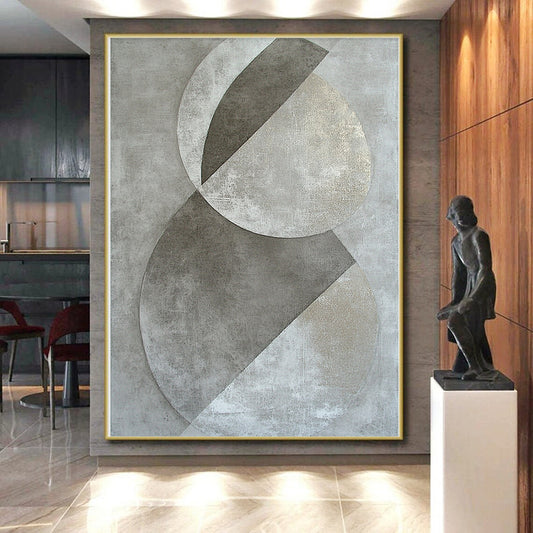
Bedrooms. Lower contrast. Gray, sand, slate, and off-white geometries calm a room; neon triangles do not. If the headboard is already a strong rectangle, choose a painting with fewer competing boxes.
Offices. Geometry reads as order. That is useful in a workspace, but a dense maze of micro-shapes becomes visual noise on video calls. Prefer larger planes and a limited palette.
Color and contrast: the two decisions that change everything
Most geometric canvases fail in homes for one of two reasons: too many colors, or not enough value contrast.
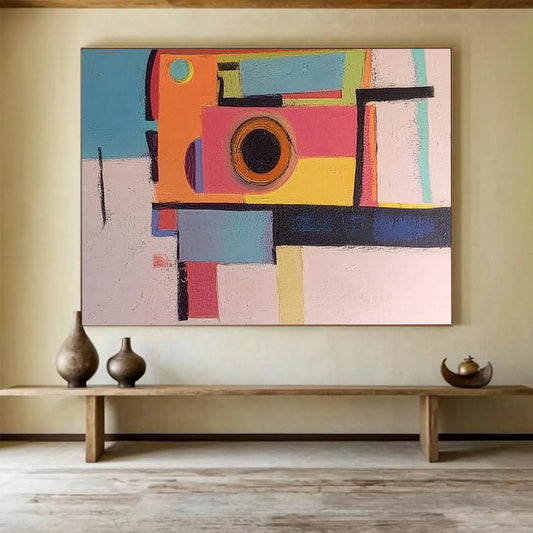
- Primary grids (red, blue, yellow, black, white) echo classic modernism. They need a quiet room—plain walls, simple sofa, little pattern.
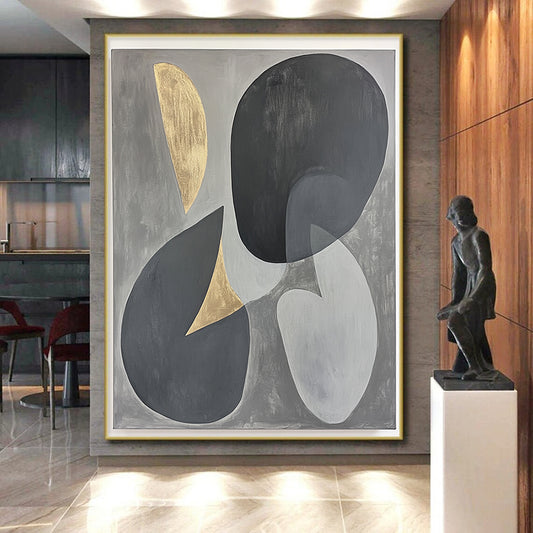
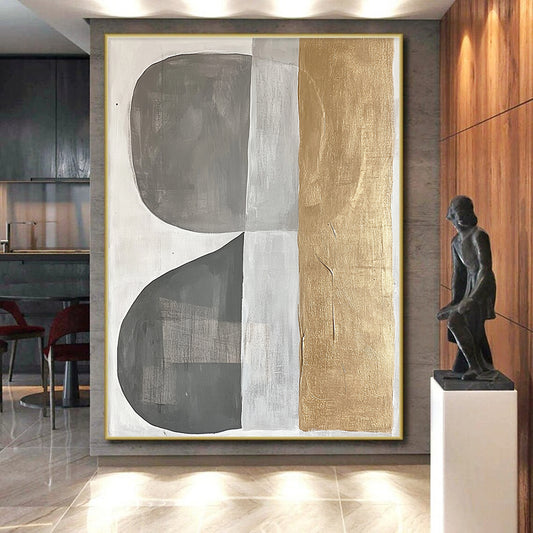
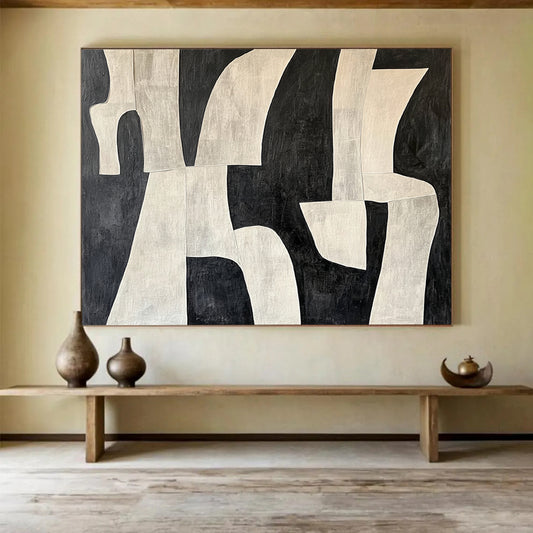
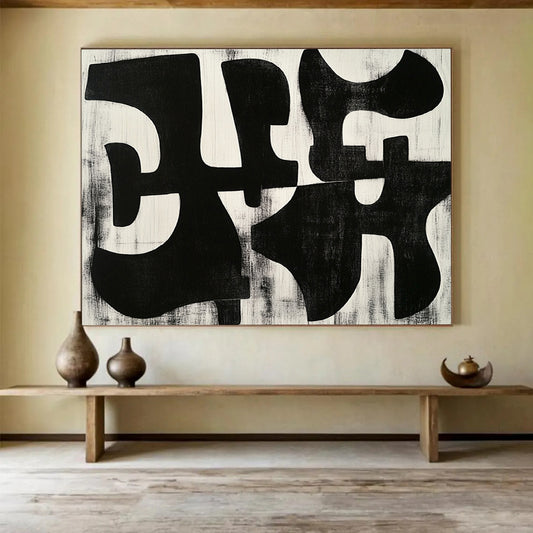
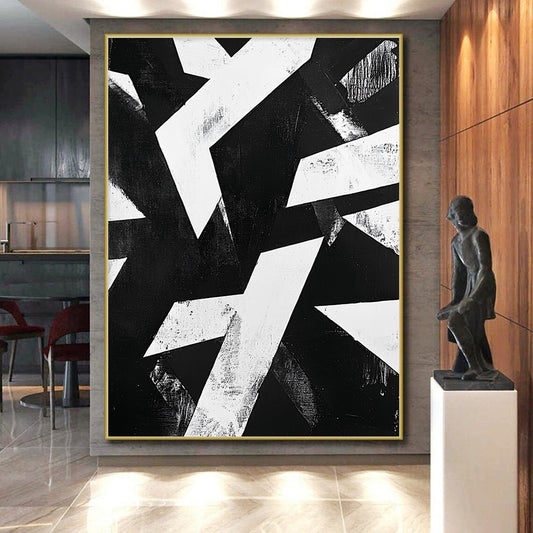
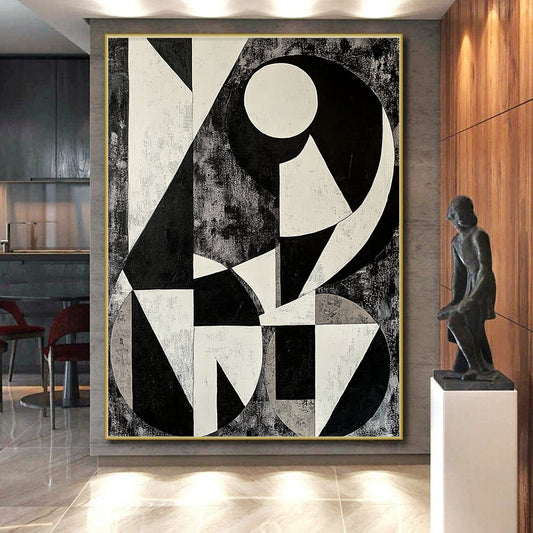
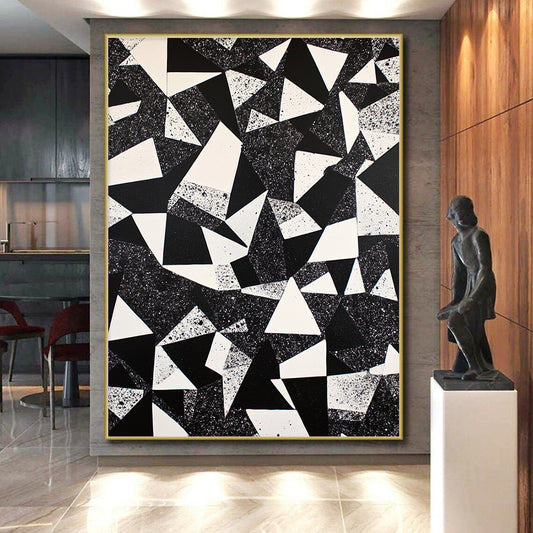
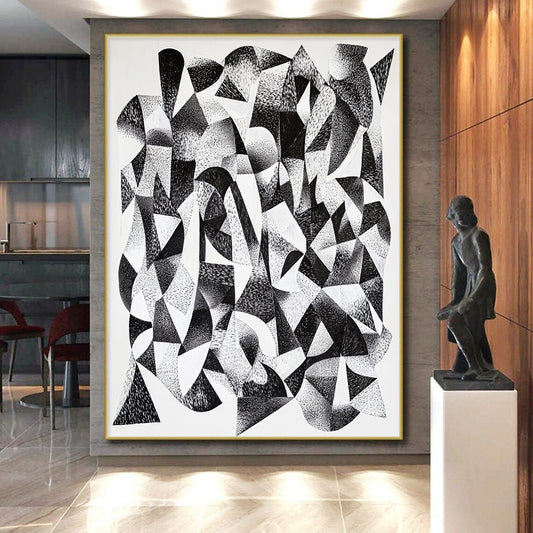
- Monochrome geometries (black, white, gray) are the safest first purchase. They scale up without shouting and sit next to both warm wood and cool metal.
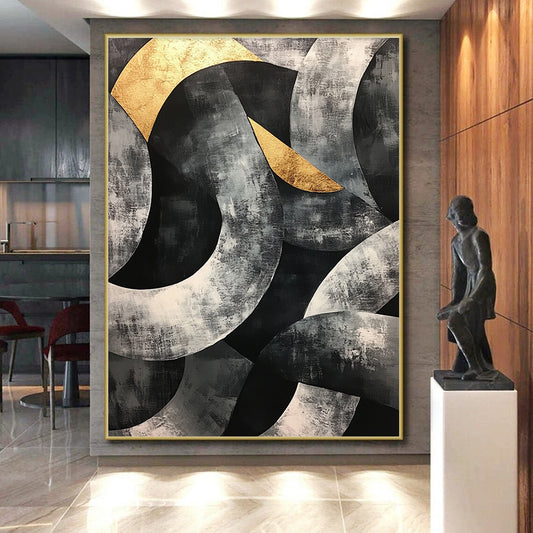
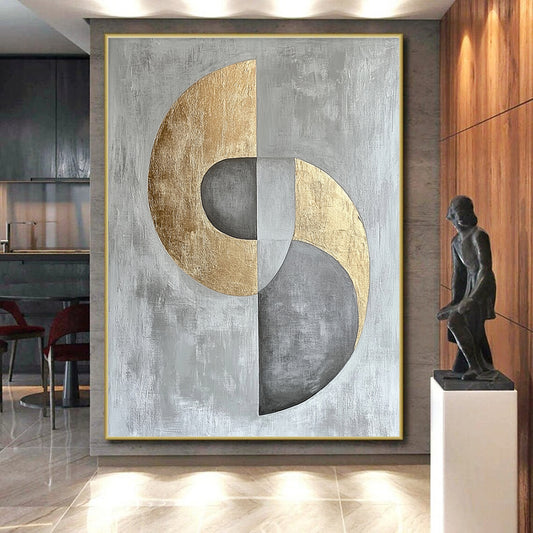
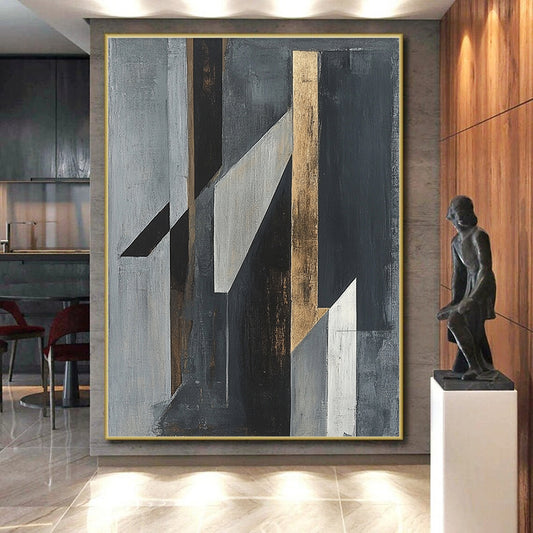
- Metal accents (gold, silver) catch light. Use them when the wall is otherwise flat and you want a slight luxury signal, not when the room already has brass lamps, gold mirrors, and veined stone.
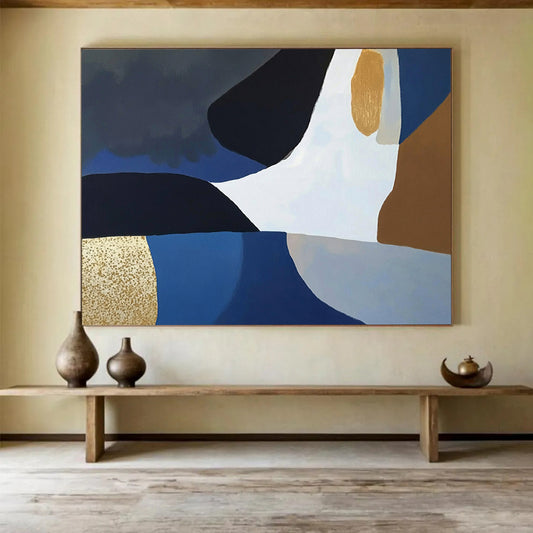
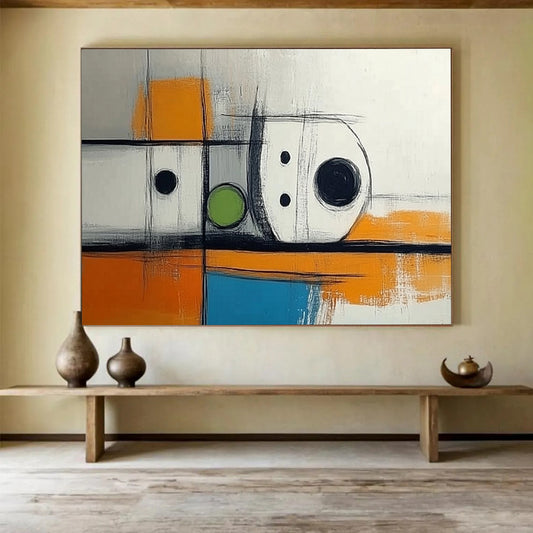
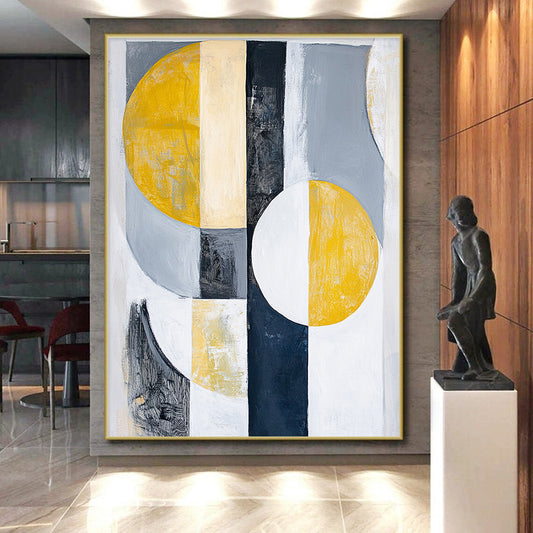
- One accent color on a neutral field is usually stronger than a full rainbow prism, unless the room is already playful.
Stand where you will actually see the painting—across the room, not six inches from a laptop—and ask whether the darkest dark and lightest light still separate. If they collapse into mid-gray, the piece will look muddy at hanging distance.
Flat print versus painted structure
A geometric design on a poster and the same design built with paint are not the same object. On a hand-painted canvas, edges can be taped-sharp or slightly broken; planes can sit flush or rise a few millimeters. Palette-knife ridges catch raking light in the evening. That physical edge is why a large custom canvas holds a wall better than a flat print of similar colors.
When you order, decide:
- Hard-edge — crisp boundaries, architectural, good for minimal rooms.
- Soft geometry — shapes remain readable, but paint is layered or scumbled. Easier in rooms with texture already (linen, oak, plaster).
- Relief / impasto geometry — triangles or bands stand off the surface. Best on a wall that gets side light; dead-on overhead light flattens the relief.
Ask for the unframed depth and whether the piece ships rolled. Oversized canvases often travel in a tube and need stretching on arrival. Budget that step if you do not have a local framer.
Sizing without guesswork
Write three numbers on a note: wall width, furniture width under the art, and ceiling height.
- Wall under 8 ft (2.4 m): one medium canvas, or a tight pair.
- Sofa wall 8–12 ft: one large horizontal, or a diptych with a small gap.
- High ceiling or stair: go taller than you think. A squat rectangle on a tall wall looks like a postage stamp.
- Custom size is the point of made-to-order work. If the niche is 71 inches, do not force a 60-inch standard and fill the rest with empty plaster.
Keep 6–10 inches (15–25 cm) of wall around the painting. Geometry needs a margin the way type needs leading.
What to commission, and what to leave alone
Commission color temperature and size. Be cautious about rewriting the whole composition unless you can describe it in two sentences (“four offset charcoal rectangles on warm white, one thin gold bar”). Geometry falls apart when every shape is negotiated separately.
Look at the painting’s outer rhythm: does the eye travel in a stable loop, or does it snag on one hot corner? If one triangle is twice as loud as the rest, it will dominate the sofa.
A short buying checklist
- Room function and viewing distance decided.
- Width based on furniture, not on the product thumbnail.
- Palette limited to two or three families.
- Edge style chosen (hard, soft, or relief).
- Shipping and stretching confirmed for large formats.
- Sample or detail photo of the actual paint surface, not only a room mockup.
Geometric work rewards restraint. The best canvases in a house are often the ones that look almost too simple in a browser and exactly right on the wall.
What size geometric painting works above a sofa?
Use about two-thirds of the sofa’s width, and hang the center of the canvas near eye level when you are standing—usually 57–60 inches from the floor to the midpoint. Leave space at both arms of the sofa so the rectangle does not feel glued to the upholstery.
Is geometric wall art the same as minimalist art?
Not always. Minimalist paintings may use almost no internal division. Geometric work is built from measurable shapes. A piece can be both—large quiet planes arranged on a grid—or geometric and busy, with many interlocking parts. Choose by how much pattern your room already has.
Will a black-and-white geometric canvas look cold?
It can, on a north-facing gray wall. Warm the scheme with oak, wool, or a cream ground inside the painting. Black, white, and one warm gray is usually less sterile than pure optical black on blue-white primer.
Should I buy a print or a hand-painted geometric canvas?
Buy a print if you need a known image cheaply and the wall is small. Buy hand-painted canvas when scale, custom proportion, and surface matter. Edges and layered paint are what make geometry hold a large wall.
Can I change the colors of a geometric design?
Yes on made-to-order work, if you keep the value structure (what is dark, what is light). Swapping navy for black is safe. Turning a two-color grid into six brights is a different painting; ask for a color study first.
How do I hang a multi-panel geometric set?
Treat the group as one rectangle. Keep gaps even and small—about 1.5–2 inches (4–5 cm)—so the grid of the painting and the grid of the panels do not fight. Map the full width on the wall with tape before you put in hooks.