How to Choose Wall Art For Office Walls That Have to Survive a Camera
An office wall has a job a living room does not. It sits behind your shoulders on a video call. It sits across from a client for an hour. It sits beside a screen that already emits light. Wall art for office use has to hold that workday without becoming the meeting. “Productivity booster” is a slogan. What you can specify is glare, chroma, and whether a stranger can spend forty minutes with the canvas without reading it as décor panic.
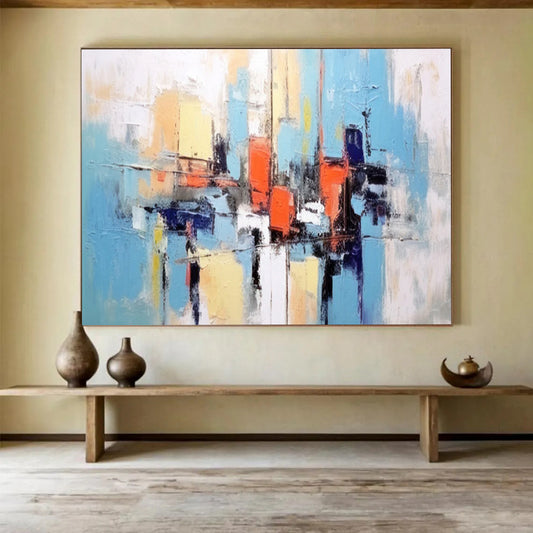
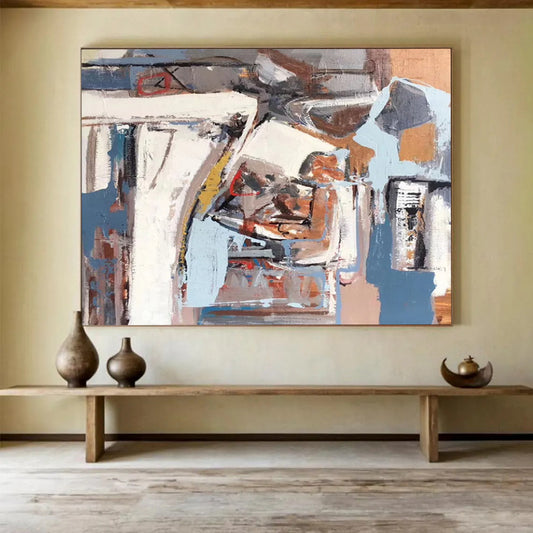
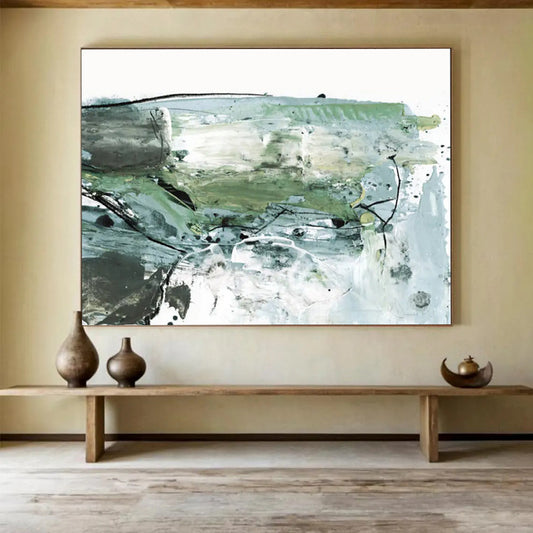
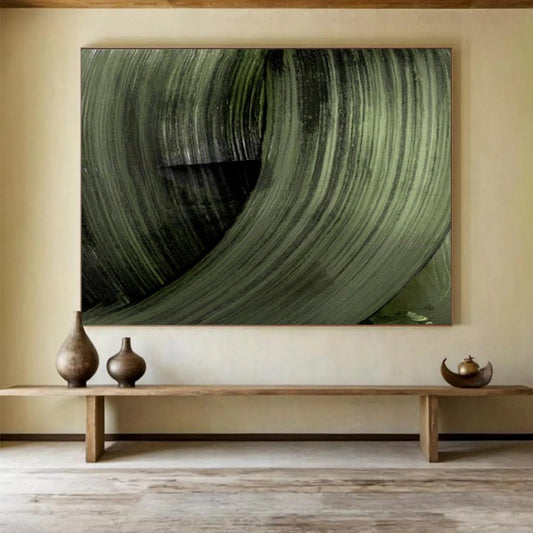
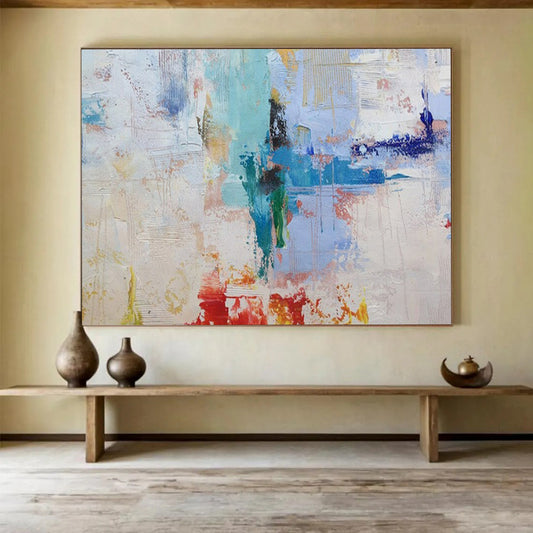
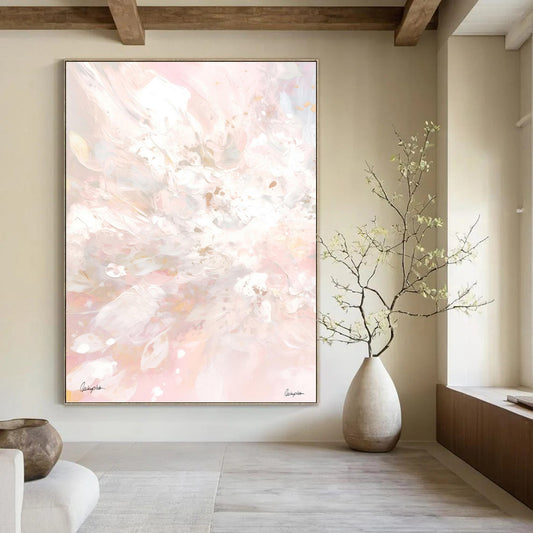
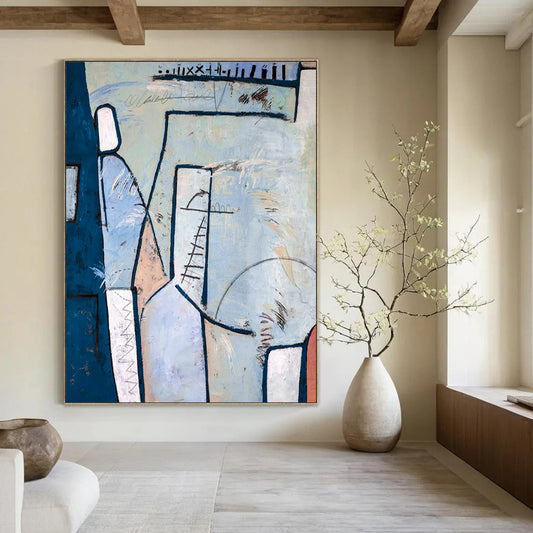
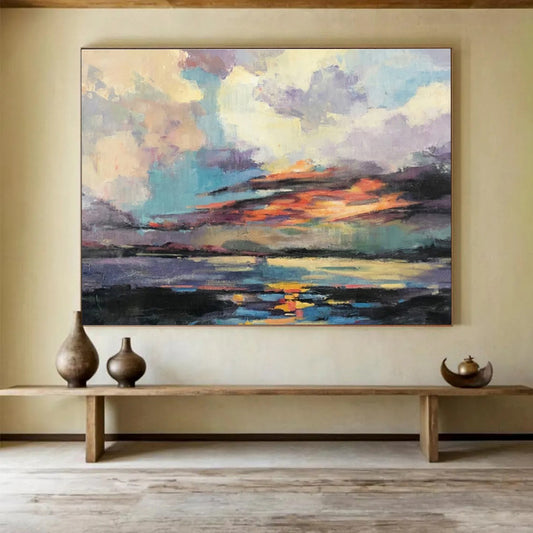
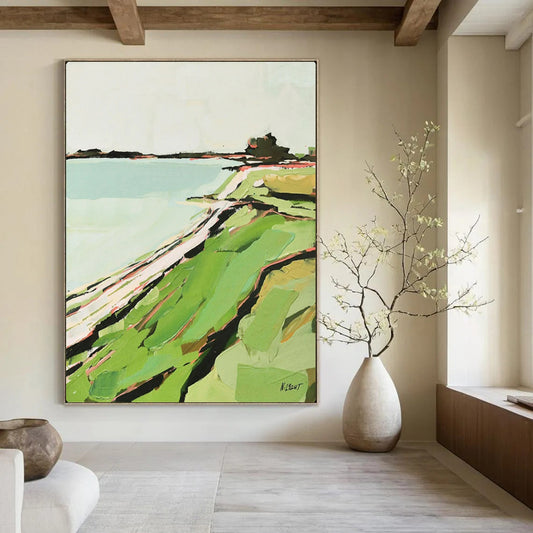
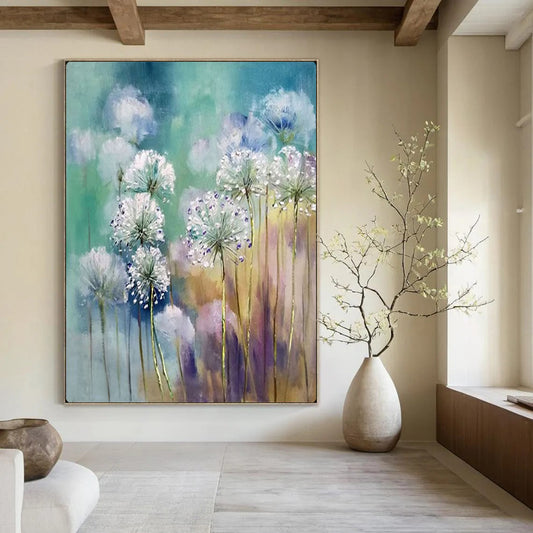
Wall Art For Office in this collection means hand-painted canvas for the plane behind a desk or the wall a visitor faces. The listing is a climate. The piece you receive is painted to order in that climate—not a nursery tree or a living-room firework wearing an office tag.
The office inherited a modern brief: art in contact with work
Tate’s glossary on the Bauhaus is the right first cut. The school wanted art back in contact with everyday life: rooms, furniture, the building as a whole. A studio wall was not a salon afterthought. MoMA’s note on the Bauhaus adds the useful word function. Materials and use mattered as much as gesture. That is an office test. If the canvas only works when the laptop is closed and the overhead lights are off, it is not office art yet.
Wikipedia’s article on De Stijl names the other half of the inheritance: reduction to structure, primary relationships, a plane that does not imitate a view. You do not need Mondrian’s grid. You need the permission to keep the wall architectural. A quiet band, a field of ash and clay, a geometric split—those read as the room thinking. A 3D autumn tree behind a CFO does not.
Two office types, two briefs:
- Client-facing or shared: mid values, lower chroma, no private jokes in the marks.
- Private home office: you can take more climate—teal-gray, olive, a dusk field—as long as the camera still sees a wall, not a poster.
The grid for this collection currently mixes foyer flowers and living-room showstoppers into the same 7,000 thumbnails. That is merchandising. Your brief is narrower. If the title needs “whimsical” or “nursery,” it is the wrong wall.
The camera is a material. So is the screen.
Sit in the chair you actually use. Open the camera. Look at the wall the other person will see. Photograph that frame with the lights you use at 10 a.m. and at 4 p.m. Measure:
- The width of the wall visible in the shot, not the whole room.
- The height from the credenza or monitor line to the ceiling in that frame.
- The competition: a window blowing out one side, a bookshelf, a glare patch from a lamp.
Give the canvas most of the visible span so the camera does not crop a timid square floating in drywall. A horizontal field usually fits a desk wall. A tall unused strip beside a filing run can take a vertical plane. Do not hang a second extra-large rectangle on the same plane as dual monitors unless one of them is clearly smaller. Two glowing boxes and one shouting canvas is a traffic jam.
Office light is unkind. Overhead LEDs are cool and flat. A window to the side will stripe the texture. A ring light will turn pale glossy peaks into a second sun on camera. Mid values and a matte or satin surface are the spec. High white ridges that look expensive in a product photo become noise in a Teams grid. Deep plaster behind a rolling chair also collects dust in a room you occupy eight hours.
Color should be brand-safe without being beige fog. Oak furniture sits with olive, clay, and warm gray. White laminate and cool LEDs sit with ash, slate, and muted teal. Neon lemon, traffic-cone orange, and fire-engine red will dominate a small frame and date the call. If you already have a company accent color, do not match it stripe for stripe; share a temperature and keep the canvas quieter than the logo.
What an office canvas should refuse
Refuse the second living room. Refuse printed “texture” that dies under LEDs. Refuse a canvas so busy that a client reads it instead of the numbers. Refuse a tiny picture centered over a wide credenza. Handmade layers are the advantage in a room of duration: a scraped trough, a band that is not perfectly taped, a gray ground that keeps heat from floating. Look for angled close shots, oil or acrylic on canvas, painted to order. Approve photos before it ships. Custom width exists for the span the camera actually sees.
A short buying order
- Open the camera and photograph the wall other people see.
- Measure that visible span, not the whole office.
- Choose structure over a showstopper.
- Match temperature to furniture and LED color, not to a logo.
- Keep sheen low enough that your face stays the brightest object.
- Review photos of the finished canvas before it ships.
Wall art for office walls is a workday-and-webcam decision. One handmade quiet plane finishes the room. A mural that wants a standing ovation does not.
What wall should office art sit on—behind me or facing me?
Behind you if the camera is the public room. Facing you if clients sit across the desk and you want the art in their view, not in the thumbnail. Do not put extra-large work on both; the office can only carry one main plane.
Will abstract art look unprofessional on a video call?
Busy, glossy, or jokey art will. A mid-value field with a clear structure usually reads as considered. If you have to explain the canvas in the first five minutes, it is too loud for that room.
Can I use the same piece in a home office and a conference room?
Only if the chroma stays quiet. A home office can take more climate. A conference room has to be livable for people who did not choose the painting.
Do overhead LEDs ruin textured paintings?
They flatten peaks and turn pale ridges into glare. Choose mid relief and a matte or satin finish. Ask for fewer white high points if the listing looks snow-capped.
How large should the canvas be relative to a desk wall?
Size it to the rectangle the camera crops, which is often narrower than the whole wall. A canvas that fills that frame looks intentional. A small square in the middle of the shot looks like a leftover.
Can I order a custom width so the art sits cleanly between two monitors and a window?
Yes. Send the visible width, a camera screenshot, and a photo with the overhead lights on. Keep the same quiet structure as the listing, and approve images of the finished surface before shipping.